
Grand County Probate Records Venue
Grand County probate matters are handled by the Probate Division function of the District Court at the Grand County Judicial Center. Colorado does not list a separate Grand County Probate Court website in the research. Probate is part of the District Court's jurisdiction, along with domestic relations, felony criminal, juvenile, mental-health, and civil matters in any amount.
That venue point controls where probate records requests go. The county Clerk and Recorder may hold recorded estate-related instruments, such as recorded deeds or other documents placed in the land records, but the estate case, letters, orders, inventories, claims, guardianship filings, conservatorship filings, and court docket belong to the state court file. The practical request path is therefore the Colorado Judicial Branch docket search for calendar clues, Data Access for authorized court data, and the Clerk of Court record/document request process for documents.
The Colorado Judicial Branch Open an Estate self-help page is the source for Colorado's timing rules and opening-estate workflow.
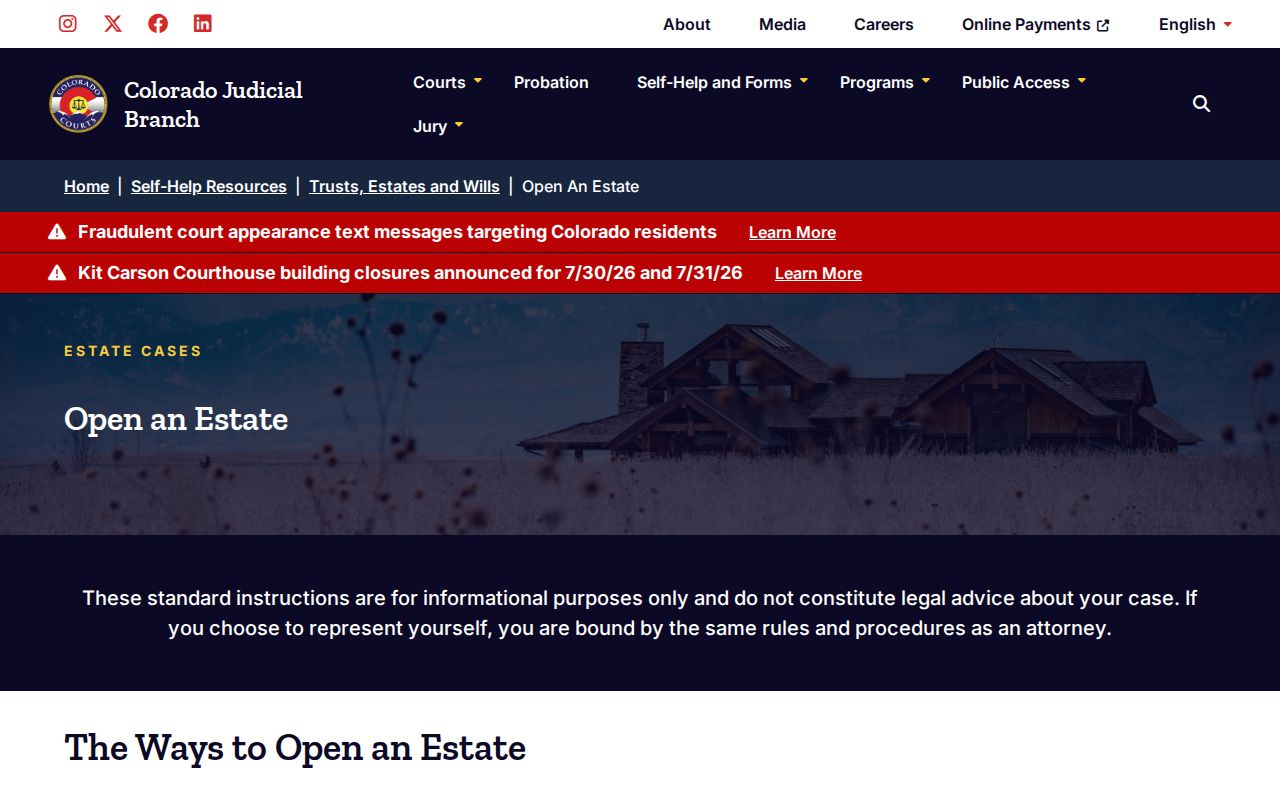
The state probate self-help page matters locally because Grand County probate filings use Colorado District Court procedures.
Grand County Probate Court Contact
There is one researched Grand County probate venue for state probate case files. The same court location handles District Court and County Court functions for the 14th Judicial District, but probate filings route to District Court because Colorado District Courts hear probate matters.
Grand County Probate Division of District Court
Grand County Judicial Center
307 Moffat Avenue, P.O. Box 192
Hot Sulphur Springs, CO 80451
970-725-3357
Monday-Friday 8:00 a.m.-5:00 p.m.; closed 12:00 p.m.-1:00 p.m.
Call before traveling near the lunch closure or before bringing unusual documents for filing. The research did not locate a courthouse-specific parking fee, security list, child waiting room, or locker rule, so those details should be confirmed with the court rather than assumed.
Grand County Probate Terms
Probate records use terms that are easy to misread. These definitions keep the search focused on the filing type and the role each person has in the case.
- Testator
- A person who made a will.
- Executor
- A person named to carry out a will. Colorado forms may also use personal representative.
- Intestate
- Dying without a will, which changes the form path and priority rules.
- Guardianship
- A case appointing someone to make personal or care decisions for another person.
- Conservatorship
- A case appointing someone to manage finances or property for a protected person.
Trust registration, personal injury settlement, creditor claim, inventory, accounting, and closing papers may also appear in a Grand County probate record, depending on the type of case filed.
A guardianship or conservatorship file may concern a living protected person, not a deceased person's estate. That distinction matters for access because medical, financial, minor, and protected-person details may be restricted even when the docket itself is visible. Estate records can also contain private account or asset information that may not be released through a public online search.
Open Grand County Estate Cases
Colorado's estate-opening rules include timing limits. The Judicial Branch open-estate material says paperwork to open an estate may be filed 120 hours, or five days, after the decedent has died. A creditor who wants to open an estate must wait at least 45 days. After forms are complete, they are taken to the probate registrar at the courthouse, and the court asks for a filing fee unless a fee waiver applies.
- Choose the correct estate path, such as probate with a will, probate without a will, small estate, or another listed probate category.
- Use the Colorado Judicial Branch probate forms and instructions for that category.
- Wait until the applicable filing time has passed before submitting opening papers.
- File with the probate registrar at the Grand County Judicial Center.
- Pay the filing fee or submit a fee waiver request if eligible.
- Use the docket search and Clerk of Court request channel for hearing dates, letters, orders, and later probate records.
For informal probate without a will, the research names JDF 907 instructions, JDF 916 application, JDF 911 acceptance of appointment, JDF 917 order, JDF 915 letters, JDF 721 power of attorney if the applicant does not live in Colorado, and JDF 912 renunciation or nomination where needed.
Grand County Probate Fees
Grand County probate filing fees come from the Colorado Judicial Branch fee schedule, not a separate county probate price list. The Judicial Branch fee list is the current court source for probate, civil, juvenile, district, county, transcript, and copy-related fees.
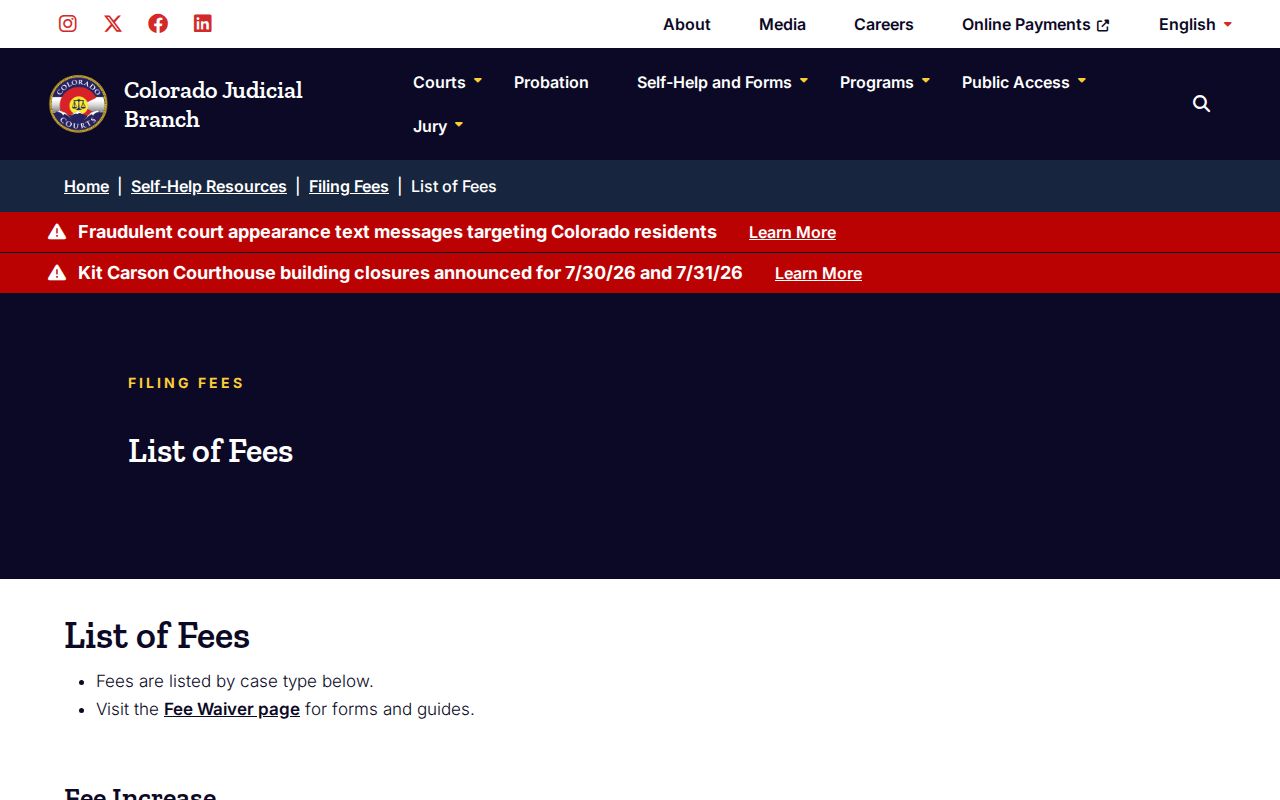
The fee-list source is useful because Grand County probate records are filed in Colorado District Court, not in a county-operated probate office. Always check the fee list before filing because court fees can change by state rule or statute.
| Probate filing | Fee | Authority or note |
|---|---|---|
| Decedent's estate, not small estate | $229 | Judicial Branch fee list, C.R.S. 13-32-102 authority shown. |
| Guardianship or conservatorship | $229 | Same probate fee category in researched fee table. |
| Personal injury settlement | $229 | Listed with probate filings. |
| Small estate | $113 | Listed separately from standard decedent estates. |
| Supervised administration except contested claims | $198 | Listed under probate fee schedule. |
| Petition for allowance of claim or contested claim | $198 | Listed under probate fee schedule. |
| Trust registration statement | $198 | Listed under probate fee schedule. |
| Petition for trust action | $229 | Fee list continues under probate section. |
| Public administrator statement | $0, $10, or $109 | Amount depends on estate value bracket in the researched table. |
The statute source assigned to this page is C.R.S. 13-32-102, which supports Colorado probate proceeding fees.
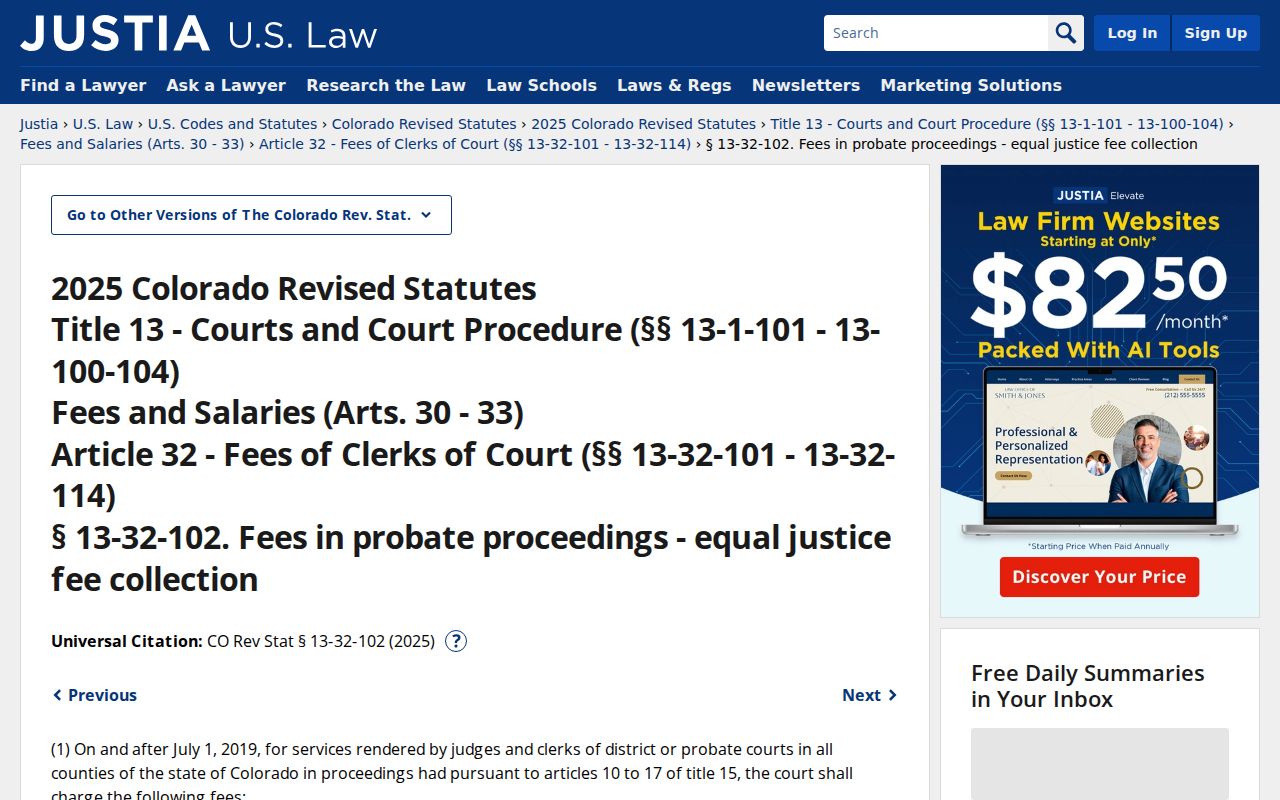
The statute image connects the fee schedule to Colorado law, while the Judicial Branch fee page remains the practical fee source.
Search Grand County Probate Records
A Grand County probate records search should start with the official court systems, then move to a document request if the docket does not answer the question. The docket search can be filtered to Grand County, District Court, and PR case class when probate is the target. It is strongest for hearing dates, case numbers, parties, attorneys, and calendar events. It is not a complete probate file download.
| Channel | Best use | Limit |
|---|---|---|
| Colorado Judicial Branch docket search | Grand County PR docket and hearing clues | Docket lists are not full case files. |
| Colorado State Courts Data Access | Authorized court data access | Login required; court data, not documents. |
| Clerk of Court record/document request | Copies, letters, orders, and file documents | Restricted probate documents may require ID or authority. |
| In-person court request | Local filing or copy request at the courthouse | Use court hours and lunch closure. |
| Grand County Acclaim or ArcaSearch | Recorded deeds or estate-related recorded instruments | Not the probate case file. |
Expected public probate docket fields include case number, year, PR case class, decedent or protected person name where public, petitioner or personal representative, attorney, filing date, hearing dates, orders, letters, inventory or accounting events, claim events, closing documents, and judge or registrar. Protected data may be withheld.
If the search concerns older family property or estate transfers, check whether the needed document is actually a recorded land instrument rather than the probate case file. Personal representative deeds, deeds of distribution, and other estate-related documents may appear in Acclaim or ArcaSearch when recorded. Wills, letters, inventories, guardianship reports, and court orders still route through the District Court case file.
Restricted Grand County Probate Records
Probate access is not always the same as ordinary civil case access. The Colorado court record/document request page warns that juvenile and probate records, or documents with confidential or protected information, may require U.S. government-issued photo ID. The court can restrict access under statutes, Supreme Court rules, Chief Justice Directives, local administrative orders, and other legal authorities.
Do not expect a public download of every will, inventory, accounting, guardianship report, conservatorship report, medical detail, minor's information, protected-person address, or financial account item. A docket may show that a Grand County probate case exists while the document itself remains restricted to parties, attorneys, fiduciaries, or people with a court order.
For a certified copy, letters of authority, or a copy that will be used with a bank, title company, retirement plan, or another court, contact the Clerk of Court before ordering. The clerk can tell the requester whether the document is available, whether ID or proof of authority is needed, and whether the request must be handled in person, by form, or through the Judicial Branch record/document request process.
Note: Recorded estate documents in Acclaim can be public while the related probate file remains controlled by the court.