
Grand County Criminal Court Records
A Grand County criminal court record is the court file for a prosecution. It begins when a charging document opens a case or moves a felony complaint toward District Court. The record is kept by the Clerk of Court for the Grand County Judicial Center, not by the county Clerk and Recorder. The 14th Judicial District Attorney prosecutes Colorado Criminal Code and Traffic Code violations for Grand, Moffat, and Routt counties, including felonies, misdemeanors, and most traffic offenses.
Criminal jurisdiction is split by court level. Grand County County Court handles misdemeanors, many traffic offenses, and felony complaints at early stages. Grand County District Court handles felony criminal cases and related post-conviction matters. A criminal case record may refer to arrest or custody, but booking status belongs to the sheriff and jail side. The full case file and outcome are the focus here; the filed charge pathway is covered separately in Grand County arrest records and court charges.
State-level criminal-history tools add another layer. The image below comes from the Colorado Bureau of Investigation records and background checks page.
CBI checks can be useful, but they are not a substitute for the Grand County court case file when pleadings, orders, or sentencing entries are needed.
Search Grand County Criminal Court Records
Start with the Colorado Judicial Branch docket search when the goal is to locate hearing activity, case class, defendant name, attorney setting, or court date. Select Grand County, the Grand County Judicial Center, and County Court or District Court if known. Criminal records commonly use CR or misdemeanor-related case classes, but the safest search uses both the case number and a date range when available.
- Use the Colorado Judicial Branch docket search to locate the Grand County criminal case calendar or event history.
- Filter by county, courthouse, court type, date range, party name, attorney name, or case-number parts.
- Review the docket for advisement, arraignment, motions, plea, disposition, sentencing, bond, probation, or restitution entries.
- Use Colorado State Courts Data Access only if authorized and only for court data, not document images.
- Request pleadings, orders, disposition papers, or certified copies from the Clerk of Court through the Judicial Branch record/document request process.
The CBI Internet Criminal History Check is the official Colorado-only name-based criminal history system. It may help with statewide criminal-history research, but it does not replace Grand County criminal court records because it is not the court clerk's case file and does not provide all pleadings or court orders.
The CBI Internet Criminal History Check source is shown below from the official CBI records check system.
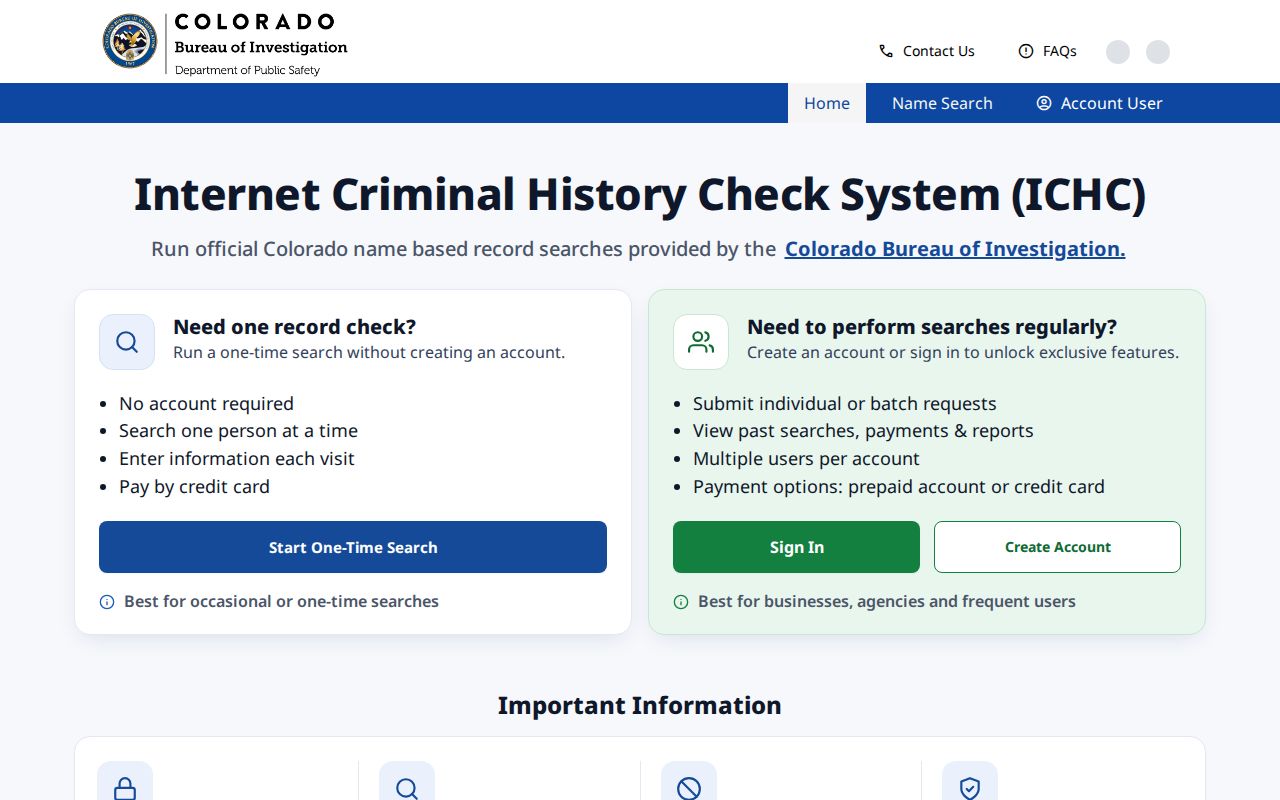
Use it as a criminal-history channel, not as proof that the Grand County court file is complete.
Grand County Criminal Case Flow
A criminal court record grows as the case moves from a filed charge to a final result. Some entries may occur quickly, such as advisement and bond orders. Others may take months, such as motions, plea negotiations, trial settings, restitution, and sentencing. The record can show events that did not end in conviction, so each charge must be read with its final disposition.
Case flow: Charges Filed › Arraignment or Advisement › Pretrial and Motions › Plea or Trial › Disposition › Sentencing
| Stage | What Happens |
|---|---|
| Charges Filed | The DA or prosecutor files a complaint, information, or other charging document with the court. |
| Arraignment or Advisement | The court addresses rights, charges, bond conditions, counsel, and next settings. |
| Pretrial and Motions | Parties file requests, exchange positions, set hearings, or resolve legal issues before plea or trial. |
| Plea or Trial | The defendant enters a plea, reaches an agreement, or the case proceeds to trial. |
| Disposition | Each charge receives an outcome, such as dismissed, deferred, pled, convicted, or acquitted. |
| Sentencing | The court may order jail, probation, fines, costs, restitution, community service, or other terms. |
What Grand County Criminal Records Show
A criminal court record is read field by field. The docket may show enough for a calendar check, while the case file is needed to confirm what was filed, ordered, or sentenced. Grand County criminal court records can also refer to bond, jail custody, probation, public defender applications, and restitution, but each of those items may involve another agency or office for details.
| Field | What It Shows |
|---|---|
| Case number | The year, case class, and sequence used to identify the Grand County criminal case. |
| Defendant | The accused person named in the court case, subject to redaction rules. |
| Charges | The counts filed by the prosecutor, including amendments or reductions when entered. |
| Bond | Bond amount, type, or conditions when the court records those terms. |
| Hearings | Advisement, arraignment, motions, review, trial, disposition, and sentencing settings. |
| Plea | The defendant's formal response, such as guilty, not guilty, or a plea agreement entry. |
| Disposition | The outcome for a charge, including dismissed, deferred, convicted, or acquitted. |
| Sentence | Jail, probation, fine, costs, restitution, or other court-ordered terms after conviction. |
The Colorado State Public Defender office serving Grand County is in Steamboat Springs, and Judicial Branch forms use JDF 208 for adult public defender applications and JDF 219 for juvenile delinquency applications. The source image below comes from the Colorado State Public Defender Steamboat Springs office page.
Defense representation can appear in a Grand County criminal court record through attorney entries, applications, motions, and orders.
Grand County Charges vs Convictions
A charge is an accusation filed in court. A conviction is an outcome after a guilty plea, verdict, or other qualifying adjudication. Grand County criminal court records may show charges that were reduced, amended, dismissed, deferred, or resolved without a conviction. For that reason, the disposition field is essential. Reading the original charge alone can overstate what happened in court.
| Point | Charge | Conviction |
|---|---|---|
| Meaning | Formal accusation filed by the prosecutor. | Final criminal finding based on plea or verdict. |
| Timing | Appears near the start of the case. | Appears after plea, trial, or qualifying case resolution. |
| Record risk | May later be changed, dropped, or dismissed. | May support sentence, probation, fines, restitution, or later sealing rules. |
| Best field to check | Charging document and amended counts. | Disposition and sentencing entries. |
Read Dispositions and Sentences
Disposition is the court outcome for a charge or case. In a Grand County criminal court record, a disposition may show dismissed, guilty plea, conviction, acquittal, deferred judgment, or another final result. Sentence is different. A sentence is the court order after conviction and can include jail, probation, fines, costs, restitution, community service, or treatment terms. A single case may have different dispositions for different counts.
Bond records can also appear in a criminal file, but current custody and bond amount questions often require the jail. Grand County Detentions instructs people to call the Sheriff's Office number and ask for the jail for bond type and amount. Bond return questions are directed to Grand County Courts.
Grand County Sealed Criminal Records
Colorado sealing rules are important for Grand County criminal court records because public docket access may not show a sealed matter. The Judicial Branch states that sealed records still exist but are hidden from public view except for authorized access. Expungement is most often discussed in the juvenile context in the research materials, and juvenile records are not treated like ordinary adult public criminal files.
| Point | Sealed | Expunged |
|---|---|---|
| Public visibility | Hidden from public view after a valid sealing order or qualifying automatic sealing. | Removed from ordinary public access in qualifying juvenile contexts. |
| Record existence | The record still exists for authorized access. | Public access is more limited, but the exact effect depends on the statute and order. |
| Grand County path | Use the Judicial Branch Seal My Case materials and file in the court that handled the case unless instructions say otherwise. | Use juvenile expungement rules and court forms when the case qualifies. |
The image below comes from the Colorado Judicial Branch Seal My Case page.
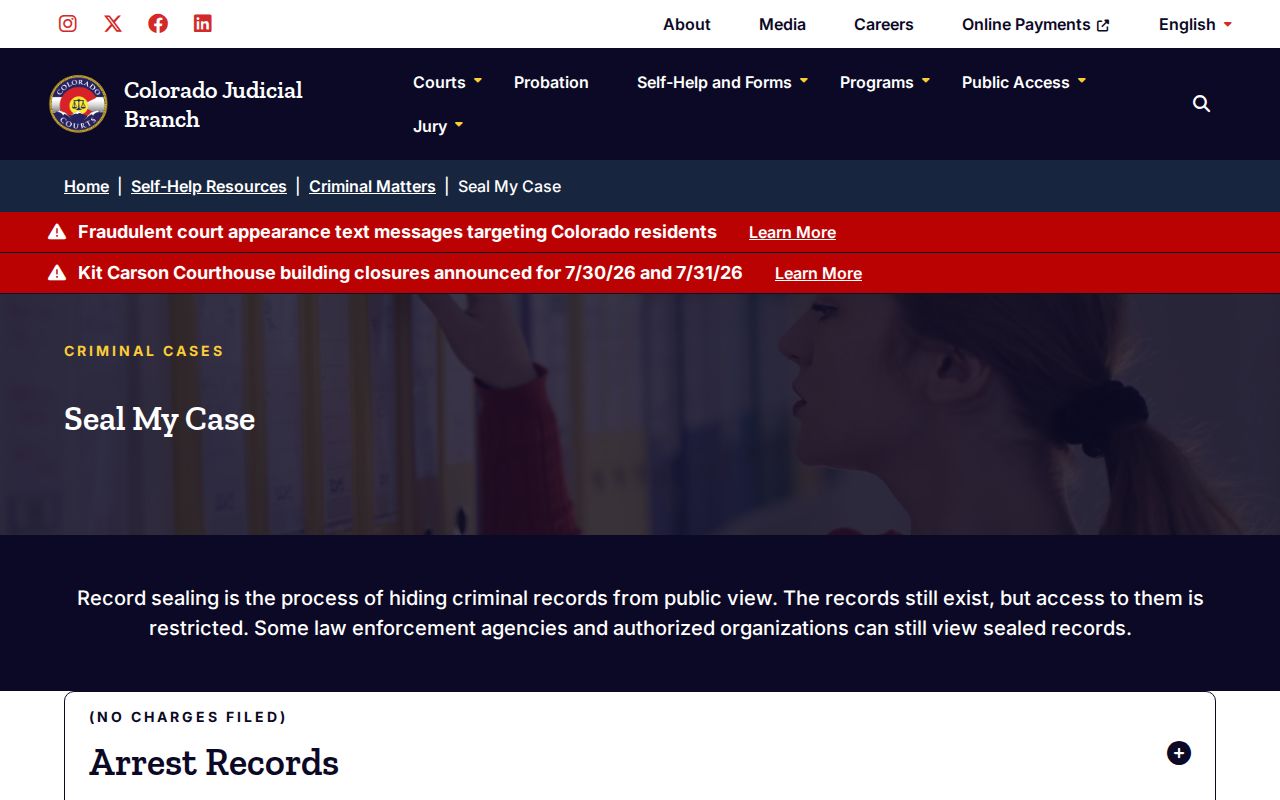
That sealing source is the safer starting point than private background sites because it separates arrest records, non-convictions, convictions, municipal convictions, identity theft, and juvenile expungement categories.
Access to Grand County Criminal Records
Criminal court access is not governed by one simple rule. Court case files are held by the Clerk of Court and controlled by court access rules, statutes, Supreme Court directives, and local orders. Criminal justice records held by law enforcement follow CCJRA. C.R.S. 24-72-301 states that official action records are open while other criminal justice records may be discretionary, and C.R.S. 24-72-305 allows denial when release is barred by law, court rule, order, or public-interest concerns.
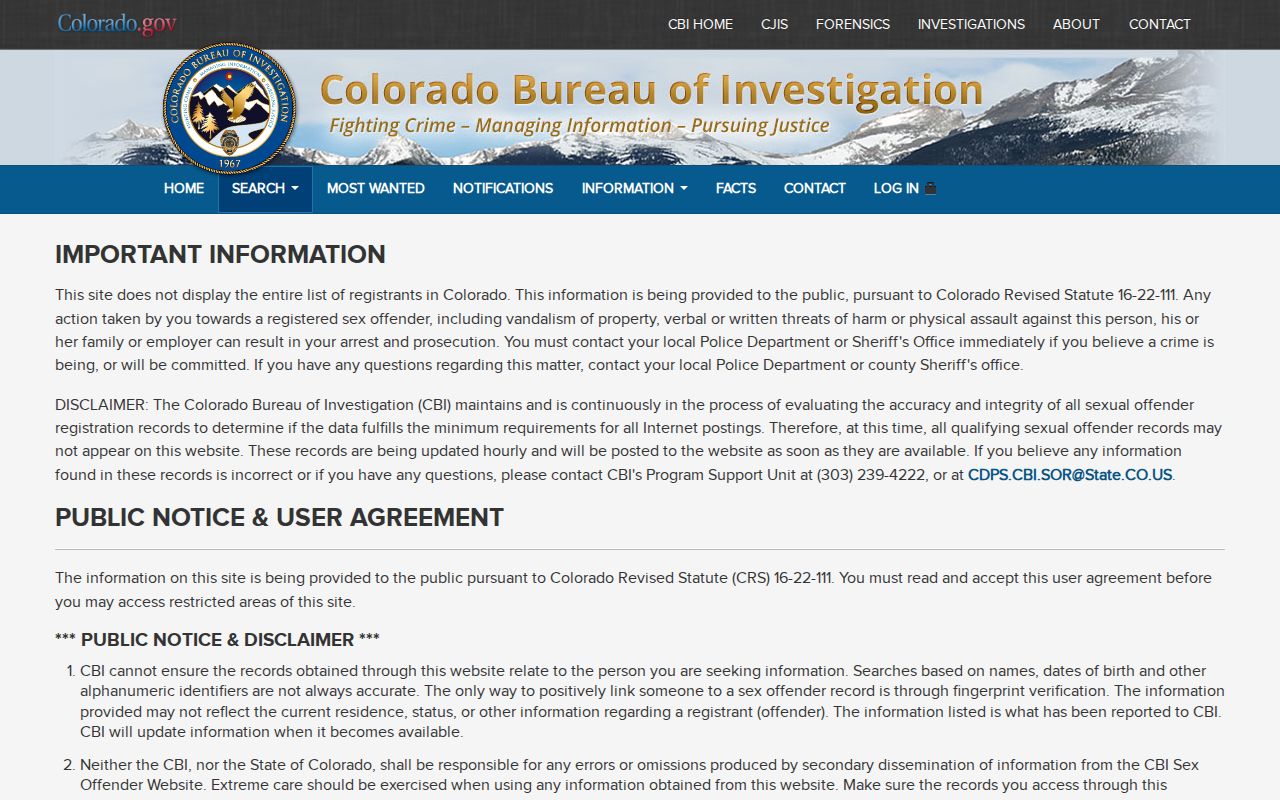
For sex offender information, Colorado provides CBI registry channels with limits. The public registry agreement warns that some categories are not shown in ordinary public search results, including misdemeanor-only and juvenile adjudication categories. The source below comes from the CBI sex offender search agreement page.
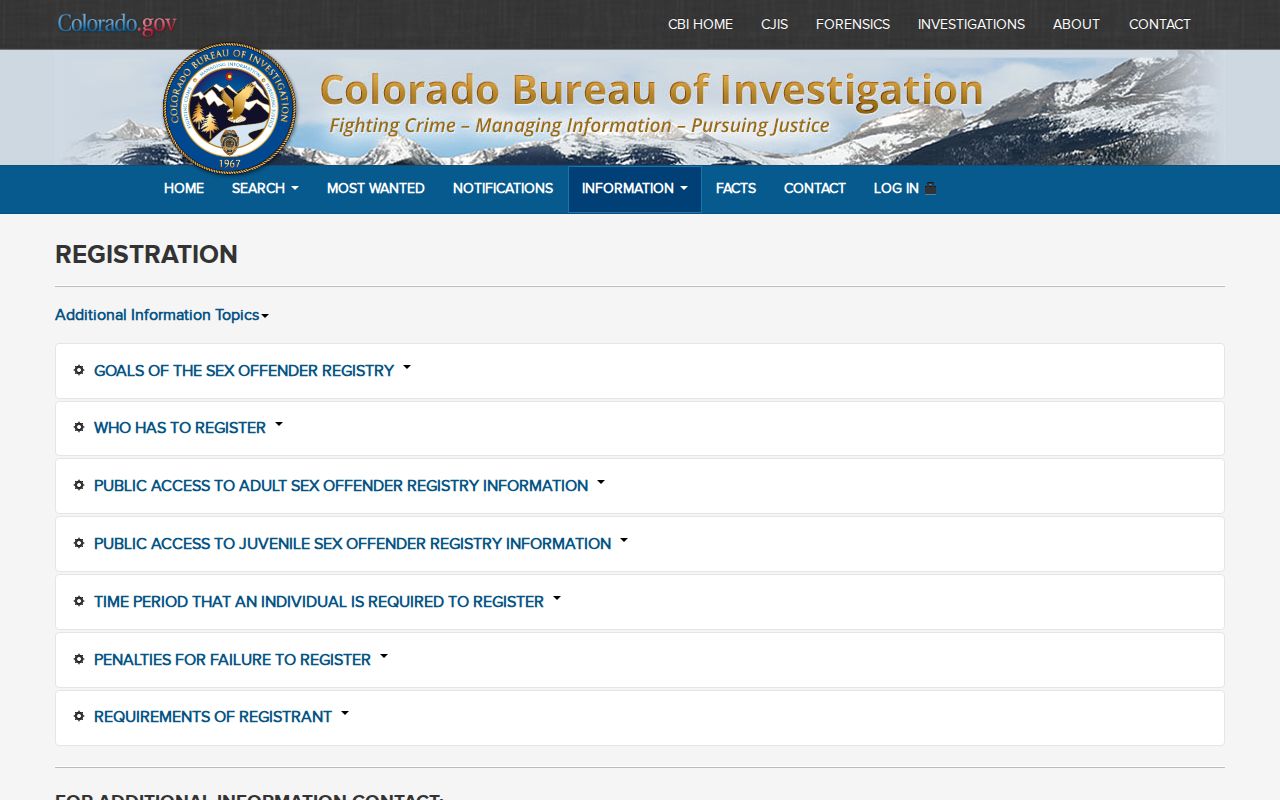
For complete adult registrant list requests, the CBI information source provides mail and in-person alternatives, shown below from the CBI sex offender information page.
Registry information should be read as a separate public-safety system, not as the complete Grand County criminal court case file.
Restricted Grand County Criminal Records
Juvenile criminal or delinquency records are restricted under Colorado law and should not be treated like adult criminal dockets. Sealed and suppressed cases may be hidden from public view. Search warrants may remain sealed while an investigation is active. Records with protected addresses, minor names, medical information, mental-health information, financial account numbers, or other sensitive content may be redacted before release.
When a criminal case is sealed, the public may not be able to confirm it through ordinary docket searches. The Judicial Branch sealed-case search confirms only automatic sealing under C.R.S. 13-3-117. It does not cover every sealing process. A party, attorney, or authorized requester may need to contact the Clerk of Court with proof of identity and a lawful basis for access.