
Grand County Arrest Records and Court Charges
Grand County arrest records are created on the law-enforcement and booking side. They may identify the arresting agency, booking status, bond type or amount, and charges known at the time of arrest when releasable. The research sources did not locate an official public online Grand County jail roster or mugshot database. Grand County Detentions instead directs people to call the Sheriff's Office number and ask for the jail for bond type and amount.
Court charges after arrest are different. The 14th Judicial District Attorney is the prosecuting office for Grand County and handles felonies, misdemeanors, and most traffic offenses under Colorado law. Once the DA or prosecutor files a complaint, information, or other charging document with the court, the charge becomes part of the criminal case record. The court charge record can then show amendments, reductions, added counts, dismissals, pleas, dispositions, and sentencing entries. The full case file and final outcome are covered in Grand County criminal court records.
Find Grand County Arrest Records
Grand County arrest records do not appear in a single official public arrest database in the reviewed county sources. The practical access chain is to call the jail for current custody and bond, request releasable sheriff records through Records Management, and search court dockets for filed charges. If a person has already been charged in state court, the Colorado Judicial Branch docket search may show hearing activity and case-number details. If the issue is a statewide Colorado criminal history after disposition, use the official CBI records check system.
- For current custody or bond after an arrest, call the Grand County Sheriff's Office and ask for or select the jail.
- For releasable arrest, incident, or booking records, use Grand County Sheriff's Records Management with the required form, photo ID, and request process.
- For filed court charges, search the Colorado Judicial Branch docket system by Grand County, court type, date range, name, or case-number parts.
- For court documents, request the complaint, information, disposition, or sentence from the Clerk of Court.
- For Colorado-only criminal history, use the CBI Internet Criminal History Check rather than private search sites.
Grand County Sheriff's Records Management accepts requests by email, fax, or in person with photo ID. The research file lists records@co.grand.co.us, fax 970-725-3227, a general three-business-day timeframe, a $15 processing and dissemination fee, and $47 per hour for research after the first hour. Criminal justice records can still be denied or redacted when release is barred by law, court rule, order, or public-interest limits.
Grand County Charges Filed After Arrest
After an arrest, the prosecutor decides what formal charges to file. The arrest may describe suspected conduct, but the court charge record starts when the charging document enters the case. The DA's office states that from arrest through resolution, it is the primary entity responsible for criminal prosecutions in the 14th Judicial District. That makes the charging document the key bridge between the sheriff booking record and the court case.
| Document | Filed By | What It Does |
|---|---|---|
| Complaint | Prosecutor or law-enforcement based filing | Starts many criminal cases or states the initial accusation for court action. |
| Information | Prosecutor | Lists formal counts, often in felony or misdemeanor prosecutions, after DA review. |
| Indictment | Grand jury process | States charges returned through a grand-jury route in qualifying cases. |
The charging document can differ from the arrest description. A person may be arrested on one suspected offense, then charged with different, fewer, more, or more precise counts after review. The docket and case file should be checked for the current charge status.
Grand County Charge Status
Charge status changes as a criminal case moves. Grand County court charge records may show a count as pending at the start, then amended or reduced by agreement, dismissed by the court, dismissed by prosecution, or resolved through a plea or trial. A single arrest can produce multiple charges, and each count can have its own status. This is why charge records should be read count by count.
| Status | What It Means |
|---|---|
| Pending | The charge has been filed and has not yet reached a final court outcome. |
| Amended | The charge text, count, statute, or level was changed after filing. |
| Reduced | The charge was lowered to a less severe count or offense level, often through negotiation or review. |
| Dismissed | The court record shows that the charge was dropped or did not proceed to conviction. |
| Deferred | The case outcome may depend on compliance with court-ordered terms before final entry. |
| Convicted | The charge resulted in a guilty plea, verdict, or qualifying criminal finding. |
Note: A filed charge is not proof of guilt; always check disposition and sentence fields before drawing a conclusion.
Grand County Charges vs Convictions
Charge records and conviction records answer different questions. A charge tells what the prosecution alleged in court after arrest. A conviction tells whether a charge ended in a guilty plea, verdict, or other qualifying final finding. Public records may show both, and some records may show charges that were dismissed or reduced. Treating every filed charge as a conviction is one of the most serious mistakes in reading Grand County arrest records and court charges.
| Point | Charge | Conviction |
|---|---|---|
| Legal meaning | An accusation filed with the court. | A final finding based on plea, verdict, or other qualifying resolution. |
| Record location | Charging document and docket entries. | Disposition, judgment, and sentencing entries. |
| Can change | Yes, it can be amended, reduced, or dismissed. | May later be sealed, appealed, or modified only through legal process. |
| Best use | Understanding what was alleged after arrest. | Understanding the final criminal outcome. |
Grand County Charge Codes
Grand County court charge records may use case classes, statutory citations, and count language. The public docket search exposes case-class options including CR, CV, DR, JV, PR, T, and others, but the docket search itself should not be treated as a legal codebook. A charge line should be read with the actual charging document, amended filings, disposition entry, and sentence. Felonies generally proceed in District Court after early complaint processes, while misdemeanors and some traffic offenses are in County Court.
Traffic charges deserve special care. The DA handles most Colorado Traffic Code violations, but some municipal traffic, parking, animal, and code citations belong to Fraser/Winter Park Combined Municipal Court or Granby Municipal Court. A municipal citation may have a local payment path and appearance schedule that is separate from Grand County state court charges.
Grand County Charge Lookup Limits
The official statewide channel for Colorado-only name-based criminal history is the CBI Internet Criminal History Check. It is different from a Grand County arrest record, a Grand County court charge record, or a current jail custody check. CBI records can help locate Colorado criminal history after disposition, but they should be compared with the actual court record when charge status, plea, sentence, or sealing details matter.
Sex offender registry information is also a separate CBI system. The CBI public registry agreement says public registry records omit some categories, and complete-list alternatives may require local law enforcement or CBI request channels. A sex offender registry result is not the same as the court's full criminal file.
Grand County Records Outside Charges
Some court-adjacent records in Grand County are civil rather than criminal. The Grand County Sheriff's Civil Division serves process, protection orders, writs, and other court papers. Its records can connect to a civil case, eviction, judgment, or protection-order matter rather than a criminal charge after arrest. The source image below comes from the Grand County Sheriff's Civil Division page.
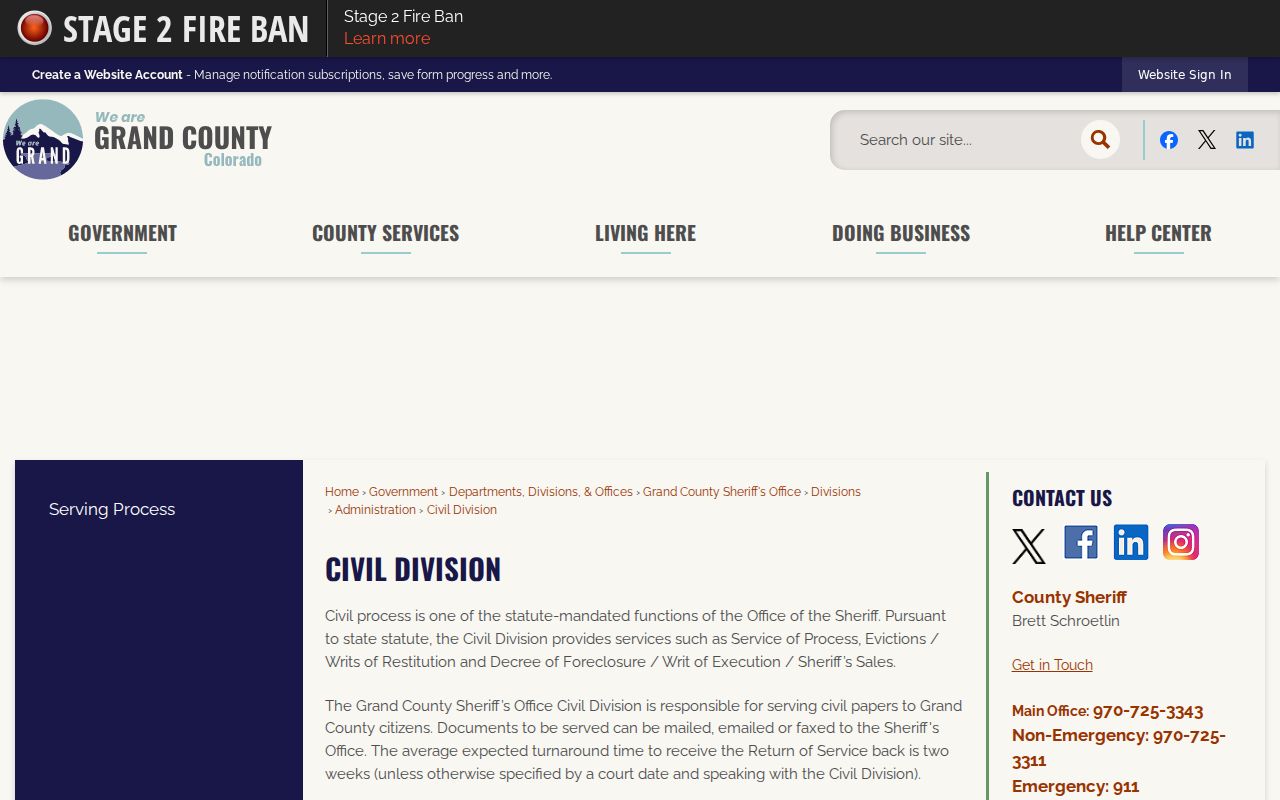
That distinction matters because service records, warrants, arrest records, and filed criminal charges can involve different custodians and different release rules.
Grand County Sealed Charge Records
Colorado sealing can hide a criminal record from public view without destroying it. The Colorado Judicial Branch says sealed records still exist and may remain visible to law enforcement and authorized organizations. Automatic sealing under C.R.S. 13-3-117 is only one category, and the Judicial Branch sealed-case search confirms only that automatic process. Other sealing categories require the correct forms and filing in the court that handled the case unless the instructions say otherwise.
| Point | Sealed | Expunged |
|---|---|---|
| Effect | Hidden from public view but still exists for authorized access. | Public access is removed in qualifying juvenile contexts or other authorized processes. |
| Common source | Colorado Judicial Branch Seal My Case forms and court order. | Juvenile expungement rules such as C.R.S. 19-1-306. |
| Record type | May involve arrest, non-conviction, conviction, municipal, or identity-theft categories. | Often discussed for qualifying juvenile delinquency records in the research file. |
Restricted Grand County Charge Records
Grand County arrest records and charge records may be restricted when the case involves juveniles, sealed matters, suppressed cases, protected addresses, medical or mental-health content, minor names, financial identifiers, active investigations, or court orders limiting access. Juvenile court records are governed by C.R.S. 19-1-304 and are not ordinary adult public records. Criminal justice records held by the sheriff may be denied under CCJRA when disclosure is prohibited by law, court rule, order, or public-interest concerns.
When the record is a court document, ask the Clerk of Court for the release path. When the record is a sheriff report or booking record, use Sheriff's Records Management. When the issue is a current bond or custody question, call the jail. Those three channels may refer to the same incident, but each one controls a different record.